News I iCET Successfully Hosts the China Sustainable Aviation Fuel (SAF) Development Workshop in Beijing
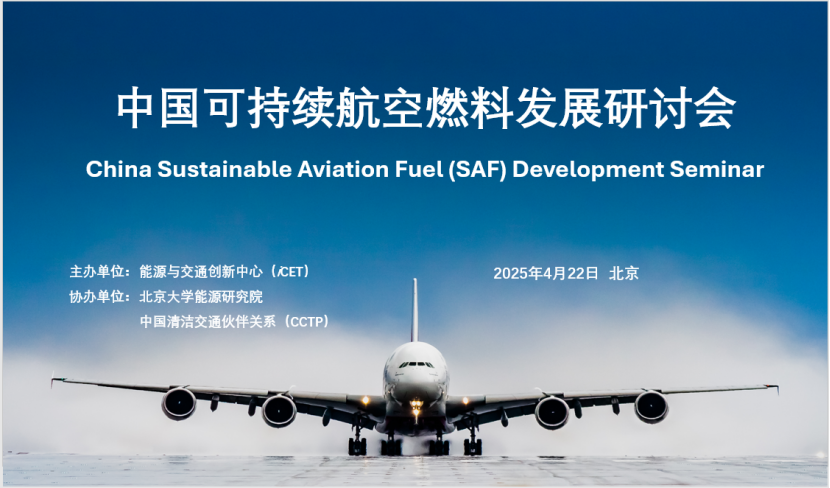
On April 22, coinciding with the 56th Earth Day, the Innovation Center for Energy and Transportation (iCET), together with the Institute of Energy at Peking University and the China Clean Transportation Partnership (CCTP), successfully hosted the “China Sustainable Aviation Fuel (SAF) Development Workshop” at the Zhongguanyuan Global Village, Peking University. The event brought together more than 50 experts and representatives from over 30 organizations, including government agencies, research institutes, airlines, SAF producers, aircraft manufacturers, and think tanks. Participants engaged in in-depth discussions on SAF technology pathways, policy development, sustainability certification, and industry coordination, and offered insights for China’s upcoming 15th Five-Year Plan, contributing to a shared vision for the green transformation of China’s aviation sector.
As the world’s second-largest aviation market, China's aviation CO₂ emissions exceeded 123 million tons in 2024. In response to the International Air Transport Association’s (IATA) 2050 net-zero target, SAF has emerged as the most critical technological pathway for aviation decarbonization. In this context, exploring China’s medium- and long-term SAF strategy is of strategic significance.
The workshop opened with speeches from Dr. An Feng, Honorary Executive Director of iCET and Executive Director of CCTP; Professor Yang Lei, Vice Dean of the Institute of Energy at Peking University; Pang Guanglian, Deputy Secretary-General and Standing Committee Member of the CPC Committee of the China Petroleum and Chemical Industry Federation; and Wang Wenwen, Secretariat Manager of CCTP. They emphasized that China is at a pivotal moment for SAF development. As SAF involves multiple sectors—including industrial and energy transition, sustainable development, and the aviation and manufacturing industries—its advancement is both challenging and full of opportunity. They expressed hope that participants would freely exchange views and contribute valuable recommendations for the long-term and sustainable development of SAF in China.

“Taking Off Green II” Released: Mapping China’s Medium- and Long-term SAF Development Pathways
iCET officially released the report “Taking Off Green II: Key Issues and Recommendations for the Medium- and Long-term Development of Sustainable Aviation Fuel in China” during the workshop. The report provides a systematic analysis of China’s SAF development status, challenges, and outlook.
According to the report, China has achieved notable progress in SAF technology pathways, pilot production, and test fueling. However, bottlenecks remain—including the lack of medium- and long-term planning, insufficient feedstock supply systems, high production costs, gaps in sustainability certification, and limited cross-sector coordination. The report calls for establishing clear SAF development targets and a national technology roadmap, as well as the creation of a Chinese sustainability certification mechanism with international compatibility to support long-term and sustainable SAF deployment.
iCET Senior Researcher Qin Lanzhi stressed the need to build a SAF development model with Chinese characteristics by leveraging policy guidance, technological innovation, industrial integration, and sustainability certification.
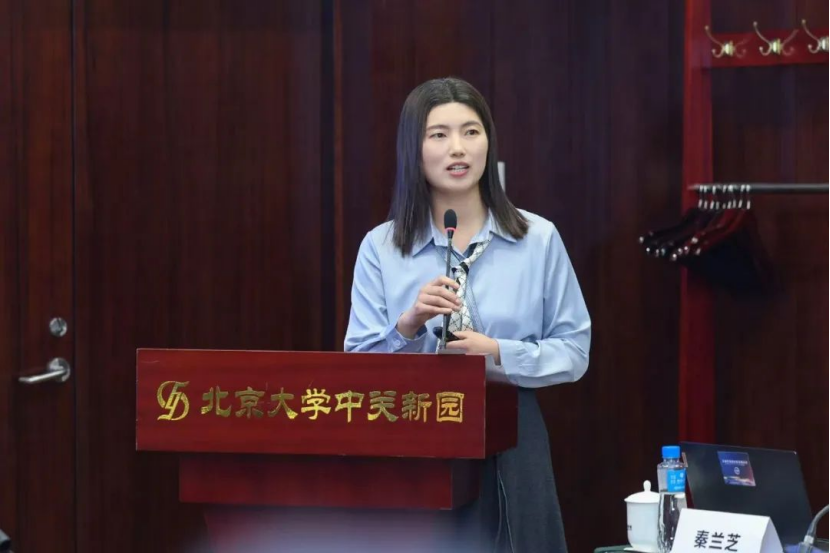
Image: iCET Senior Researcher Qin Lanzhi presenting the report
Launched in 2023, the “Taking Off Green” series is iCET’s flagship research program on aviation decarbonization and SAF development, aimed at accelerating scaled production and deployment of SAF in China.
Panel Discussion: Exploring How to Build and Strengthen China’s SAF Industry Chain
During the roundtable session themed “Pathways for the Green Transformation of China’s Aviation Industry,” Professor Yang Lei, Vice Dean of the Institute of Energy at Peking University, served as the moderator and engaged in an in-depth dialogue with seven senior experts from the NDRC Energy Research Institute, the China Petroleum and Chemical Industry Federation, the Sinopec Research Institute of Petroleum Processing, Tsinghua University, the Civil Aviation University of China, Boeing China, and Cathay Pacific Airways.
The discussion focused on several key issues, including the formulation of China’s SAF development targets and supporting policy framework; technological progress in aircraft safety and compatibility; regulatory and technical challenges; and the major obstacles encountered in SAF pilot applications. Panelists exchanged views enthusiastically, offering diverse insights into the future deployment of SAF in China.
Experts discussed the formulation of national SAF targets and supporting policy frameworks, technical and regulatory challenges related to aircraft safety and compatibility, and the obstacles encountered during SAF pilot applications.
During the panel titled “Medium- and Long-term Technology Pathways for SAF Development in China,” Dr. An Feng, Honorary Executive Director of iCET and Executive Director of CCTP, served as the moderator. He engaged in an in-depth discussion with frontline experts from seven companies—including the Global Green Fuel Center, Parity Group, MotionECO, Shougang Lanze Tech, SAFPAC Limited, Guangdong Mingyang Wind Power Industry Group Co.,Ltd. and Honeywell—on multiple SAF technology pathways such as HEFA, AtJ, gasification–Fischer–Tropsch, and PtL.
Panelists shared updates on their respective technology solutions, collectively outlining a technical landscape of China’s emerging SAF industry chain. The discussion revealed both competition and convergence among diverse technology routes, while highlighting a key consensus: China’s SAF feedstock system is evolving from a UCO-dominated single pathway toward a diversified mix of biomass, green electricity, and carbon recycling.
Another thematic session focused on “SAF Industry Policies and Sustainability Certification Mechanisms.” Moderated by Guo Jie, Director of Global Sustainable Transport innovation and Knowledge Center for Sustainable Transportation Innovation and Knowledge, the session featured six speakers representing Beijing Zhongtan Zhonghe Certification Services, Tsinghua University, Beijing Green Exchange, Airbus China, China Quality Certification Centre (CQC), and SCS Global Services.
Their discussions covered critical topics such as the identification and design of SAF policy instruments, the establishment and mutual recognition of sustainability certification systems, capacity-building needs, and the feasibility and challenges of incorporating SAF into carbon market mechanisms. The session aimed to accelerate the development of a China-specific SAF sustainability certification and incentive framework that is robust, internationally compatible, and aligned with national characteristics.
As the first workshop in China focusing simultaneously on SAF medium- and long-term targets, ecosystem building, and full value-chain development, discussions directly confronted key challenges such as feedstock competition, technology prioritization, policy design, sustainability certification, and cross-sector coordination.
iCET announced that key insights from the workshop will be compiled into a formal meeting summary and submitted through official channels to the National Energy Administration, the Civil Aviation Administration of China, and other relevant authorities, contributing expert input to the formulation of the 15th Five-Year Plan.
Advancing SAF is not only a technological mission but also a strategic choice for China as it fulfills climate commitments and cultivates new green industrial competitiveness. At this pivotal planning juncture, iCET looks forward to working with stakeholders across the value chain to inject new momentum into SAF development and accelerate the green, low-carbon transformation of China’s civil aviation sector.