Research Reports

Evaluating California’s Zero-Emission Vehicle (ZEV) Credits and Trading Mechanism and its Potential Suitability for China
The report introduces the innovative California ZEV-Credits program and evaluates its effectiveness through a case study of the world’s leading electric automaker Tesla Motors, experts interviews, quantitative impact assessments, and extensive meta-analysis. The report has demonstrated the capacity building the ZEV credits program provides for small manufacturers in a fast evolving and highly dominated market place. As identified by national and local key stakeholders, a similar scheme tailored for China may advance local technology solutions and vehicle standard implementation, and be linked to broader emissions trading platforms.

2014 China Annual Corporate Average Fuel Consumption (CAFC) Report
This year’s report is iCET fourth annual report which tracks China’s fuel economy implementation status, trends and recommendations.This year report is unique as it examines the first-ever corporate reported average fuel consumption recently made publicly available by MIIT,studies new energy vehicles potential contribution to auto manufacturers in meeting their limits and standards; identifies trends and implementation issues by corporate type (importing, independent domestic manufacturers etc.), and provides policy recommendations towards the new standard design and implementation.
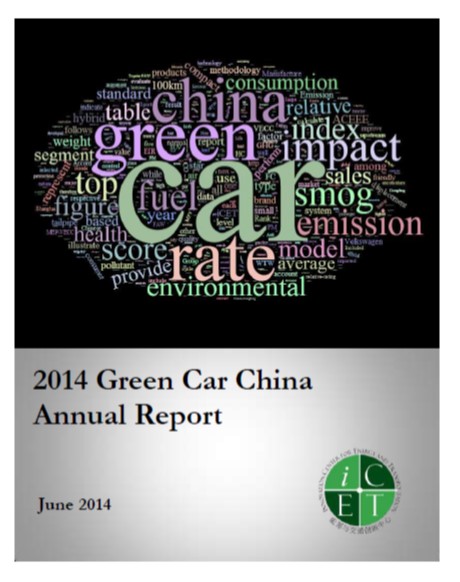
2014 Green Car China Annual Report (June 2014 / Clean Transportation Program)
China's MEP joined forces with iCET on marketing and improving this year's China Green Car (previously named EFV) report. Vehicle emissions of about 90% of China's model year 2013 vehicles are based on Type Approval tests rather than on China's emissions standard targets. Furthermore, a ranking of China's Top 50 sales' vehicles was added to this year's typical nine vehicle segments (Small, Compact, Medium, Large, Luxury, SUV, SPV, Sports cars, Hybrid), and separate smog index scores were added to the traditional EFV report's green rating values to indicate vehicles' air-quality impacts.
AB 32 Training Manuals VI:“A Review on Fuel Suppliers of California’s Cap-and-Trade Scheme” (June 2014 / Carbon Management Program / CHINESE)
The biggest highlight of the upcoming second compliance period of California cap-and-trade system is the new covered sector in 2015: fuel suppliers. Fuel suppliers will be the biggest covered sector considering that their compliance obligation will be about half of the covered emissions of the whole carbon market. iCET recently published a report in which fuel suppliers’ coverage and threshold, compliance obligation, compliance approaches, and other control requirements under California cap and trade system are illustrated. Peers, like Carbon pilots in China and California carbon market, tend to face the same challenges and opportunities. The regulation of fuel suppliers is just one approach toward the inclusion of transportation emissions into the cap and trade system, and California’s outcome would make a good case study for China’s pilots to learn from.
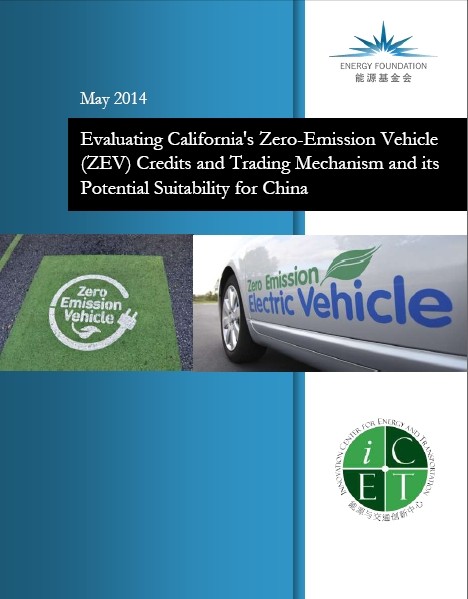
Evaluating California’s Zero-Emission Vehicle (ZEV) Credits and Trading Mechanism and its Potential Suitability for China (May 2014 / Clean Transportation Program)
Although China has committed itself to ambitious energy consumption reduction policies and has already started incentivizing the commercial development of New Energy Vehicles (NEVs) and related infrastructure, it is clear that more aggressive, comprehensive, and innovative approaches are in need. The California ZEV-Credits scheme has been identified as a truly innovative program with high contribution value to support low-carbon development while greatly incentivizing market players to innovate commercial solutions. The ZEV-credits scheme has recently received the attention of national decision-makers (among which are NDRC, MOF, MIIT) as well as local planners (mainly local DRCs). iCET’s “Evaluating California’s Zero-Emission Vehicle (ZEV) Credits and Trading Mechanism and its Potential Suitability for China” report, supported by the Energy Foundation, was released earlier this month. Through the single case study of global electric car leader Tesla Motors, this work has demonstrated the capacity building the ZEV credits program provided for small manufacturers in a fast evolving and highly dominated market place.
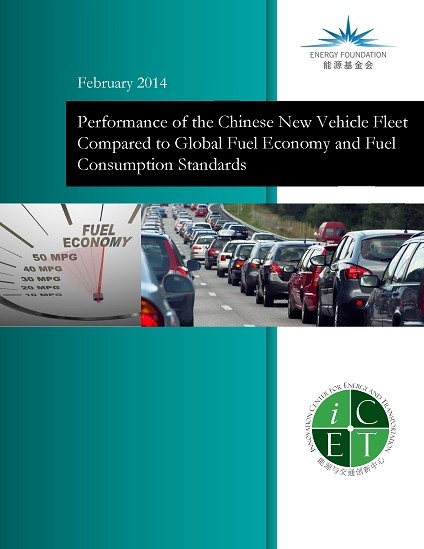
Performance of the Chinese New Vehicle Fleet Compared to Global Fuel Economy and Fuel Consumption Standards(February 2014 / Clean Transportation Program)
This study attempts to provide policy-makers with the tools to consider the adoption of footprint-based standards (recently adopted in the US), and evaluate the relative stringency of national standards against the EU and Japan’s standards. First, this paper introduces selected global standards (namely US, EU, Japan, and China), outlines their historic development and evaluates their implementation success, and then the methodology and results are outlined.
AB 32 Training Manuals V:“A Review on the Electricity Sector of California’s Cap-and-Trade Scheme” (December 2013 / Carbon Management Program / CHINESE)
As a primary source of greenhouse gas, the electricity sector is one of the most regulated sectors and is a key participant of the carbon market. This report introduces the market structure and price setting of the electricity sector in China and the U.S., especially California. The report further discusses the allowance budget, allocation mechanism, compliance regulation, revenue allocation, and related impacts of the electricity sector in California’s cap-and-trade scheme. All the specific regulations on California’s electricity sector provide an excellent foundation for cap-and-trade pilots in China.

AB 32 Training Manuals IV:“A Review on Offset Projects of California’s Cap-and-Trade Scheme” (November 2013 / Carbon Management Program / CHINESE)
Covered entities may sell their offset credits as a compliance instrument in California’s cap-and-trade scheme. The design of regulation -- such as requirements for compliance offset protocols, types of offset credits, offset credits creation process, requirements and processes for offset credits issuance, and so forth -- is crucial to a cap-and-trade scheme. This report therefore offers a basic reference for the establishment of China’s carbon market.

AB 32 Training Manuals III:“Brief Introduction on the Cost Control Mechanism of California’s Cap-and-Trade Scheme”(August 2013 / Carbon Management Program / CHINESE)
This report compiles what was achieved from ARB’s workshop held in June 2013, which discussed cost control related issues. We hope that the report will offer references for China’s carbon market, which do not yet have regulations and rules for cost control of the pilot cap-and-trade schemes.

AB 32 Training ManualsⅡ:“2013 Work Plan of California’s Cap-and-Trade Scheme” (July 2013 / Carbon Management Program / CHINESE)
According to the timetable published on the ARB’s website, this report gives a brief introduction on the work plan of California’s Cap-and-Trade Scheme in 2013 in terms of offset program implementation, product-based benchmarks, allowance allocation, auction and trading requirements, and emissions leakage.