Best Electric Commercial Vehicle (BestECV)

The firm commitment to achieving zero-emission transportation poses a significant challenge to the currently uneven market development of new energy commercial vehicles across different application scenarios. The Best Electric Commercial Vehicle (BestECV) project was launched in July 2020. By establishing a comprehensive, user-friendly electric commercial vehicle query platform based on a transparent and open methodology, the project analyzes the deployment feasibility of various new energy commercial vehicle models from the perspectives of vehicle specifications, applicable scenarios, cost-effectiveness, environmental benefits, and application cases, systematically reviewing the current status, development prospects, and pathways for commercial vehicle electrification, in order to better facilitate the implementation of the commercial vehicle electrification transition.
Fleet Electrification Accounting Tool:
Provides fleet managers with decision support for the entire electrification transition process. After two steps of inputting fleet positioning and profiling, the tool outputs accounting results in real time, including core indicators such as the Total Cost of Ownership (TCO) payback period, aiding in preliminary estimation and planning.
Vehicle Selection:
Integrates mainstream electric commercial vehicle resources, allowing users to filter suitable models, conduct multi-vehicle horizontal comparisons, and perform benchmarking against conventional fuel vehicles, using intuitive data to support their vehicle purchasing decisions.
Scenario Electrification Assessment:
Based on 14 indicators integrating the DELPHI expert survey method and combined with a national commercial vehicle database, the project assesses the feasibility of electrification across six key commercial vehicle scenarios, providing multi-dimensional decision support for the transition.
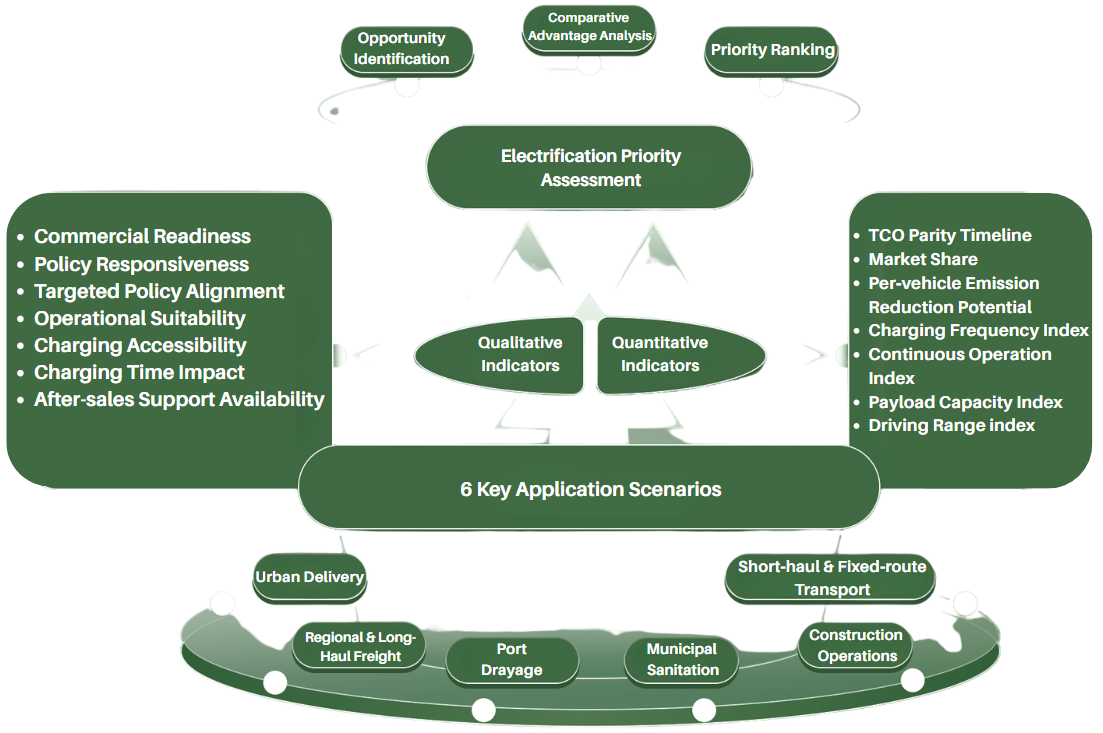
In April 2025, the BestECV project released the BestECV™ Accounting Model — a comprehensive toolkit for fleet electrification assessment — targeting key application scenarios including urban distribution, trunk-and-feeder line transport, port collection and distribution, short-haul and fixed-route transport, construction engineering, and urban environmental sanitation. The toolkit provides fleets with multi-dimensional analysis covering TCO, investment and returns, fleet charging infrastructure solutions, and emission reduction benefits, serving as a reference for fleet electrification transitions.

Fleet Electrification Accounting
Step 1: Fleet Positioning – Select application scenarios and vehicle types based on actual operational needs.
Step 2: Fleet Profiling – Input comprehensive fleet information, including parameters related to procurement, operations, benchmark vehicles, and charging solutions.
Step 3: Output & Analysis – Based on input parameters, obtain real-time accounting results covering core indicators such as TCO payback period calculation, return on investment analysis, charging solution recommendations, and carbon and pollutant emission reduction accounting, providing a scientific and comprehensive preliminary assessment for fleet electrification.

Website: http://www.bestecv.com